I’ve been a fan of Latin jazz for many years. I can remember as a child hearing Pérez Prado or Xavier Cugat records (or later watching Desi Arnaz perform “Babalu” on TV) so the stage was set early. But I’d guess that the strongest influence on me was what occurred in the Sixties — the beginning of what came to be known as the bossa nova era.
You can point to a lot of different events as the beginning of the movement, but most experts agree that one of the seminal moments occurred when saxophonist Stan Getz and guitarist Charlie Byrd recorded Jazz Samba. Although both performers were already known  and respected by jazz fans, that album — and its huge hit, “Desafinado” (clip) — gave a big bump to both musicians’ careers. But here’s something you might not know — it was Byrd’s idea.
Although Latin jazz was the farthest thing from his mind while growing up in Virginia, Charlie Byrd was musically inclined and was already an accomplished acoustic guitarist when he was stationed in Paris near the end of World War II. It was a time and place that was significant because it allowed him to spend some time listening to legendary Gypsy jazz guitarist Django Reinhardt perform. (And possibly even play alongside him, although that detail is a little fuzzy.)
In any case, Byrd took inspiration from the encounter, along with a sensibility of how the guitar could be used in jazz. Building on that in the post-war years, he had some success in the jazz world but by the Fifties had decided to study classical guitar. For the next few years he spent much of his time working with classical guitarists Sophocles Papas and Andres Segovia, but eventually moved back to jazz.
A 1961 tour of South America sponsored by the U.S. State Department was the catalyst for his next career change, because Byrd discovered the emergence of a new musical movement — the bossa nova. He made 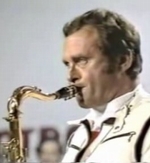 some tapes of the music and was soon back in the U.S. playing them for Getz and record company officials. Their land-breaking album followed.
Both Getz and Byrd continued to find Latin jazz a fertile ground for record sales for many years, each generating countless albums, and in many case reprising some of their original album’s hits in different versions. A good example is Byrd’s ‘sax-less’ recording of “Desafinado” that instead allows his guitar to carry the melody.
Charlie Byrd was an active part of the musical world for decades, and although most of his body of work leaned toward Latin jazz, he still moved in other directions from time to time. In fact, he wasn’t afraid to tackle the occasional pop tune, and when he died in 1999 the video below would have been perfectly appropriate — it’s his version of the Beatles’ “While My Guitar Gently Weeps.”

 Geezer Music Club